TRAINING SCIENCE · 7 MIN READ
Slow-Twitch vs Fast-Twitch: What It Actually Changes In Your Training

Fiber types are real, and the proportions really do differ from one muscle to the next. But when researchers trained one calf heavy and the other light for eight weeks, both grew the same amount.

The Claim
You have heard the rule. Calves and abs are slow-twitch endurance muscle, so they need high reps and long, burning sets. Chest and hamstrings are fast-twitch power muscle, so they need heavy weight and low reps. Match the rep range to the fiber and the muscle finally grows.
It is a satisfying rule because it explains a real frustration. Calves are stubborn. Plenty of people have hammered heavy sets of eight at them for years with nothing to show. A biological reason for that failure feels better than the alternative, which is that calves are just slow to change.
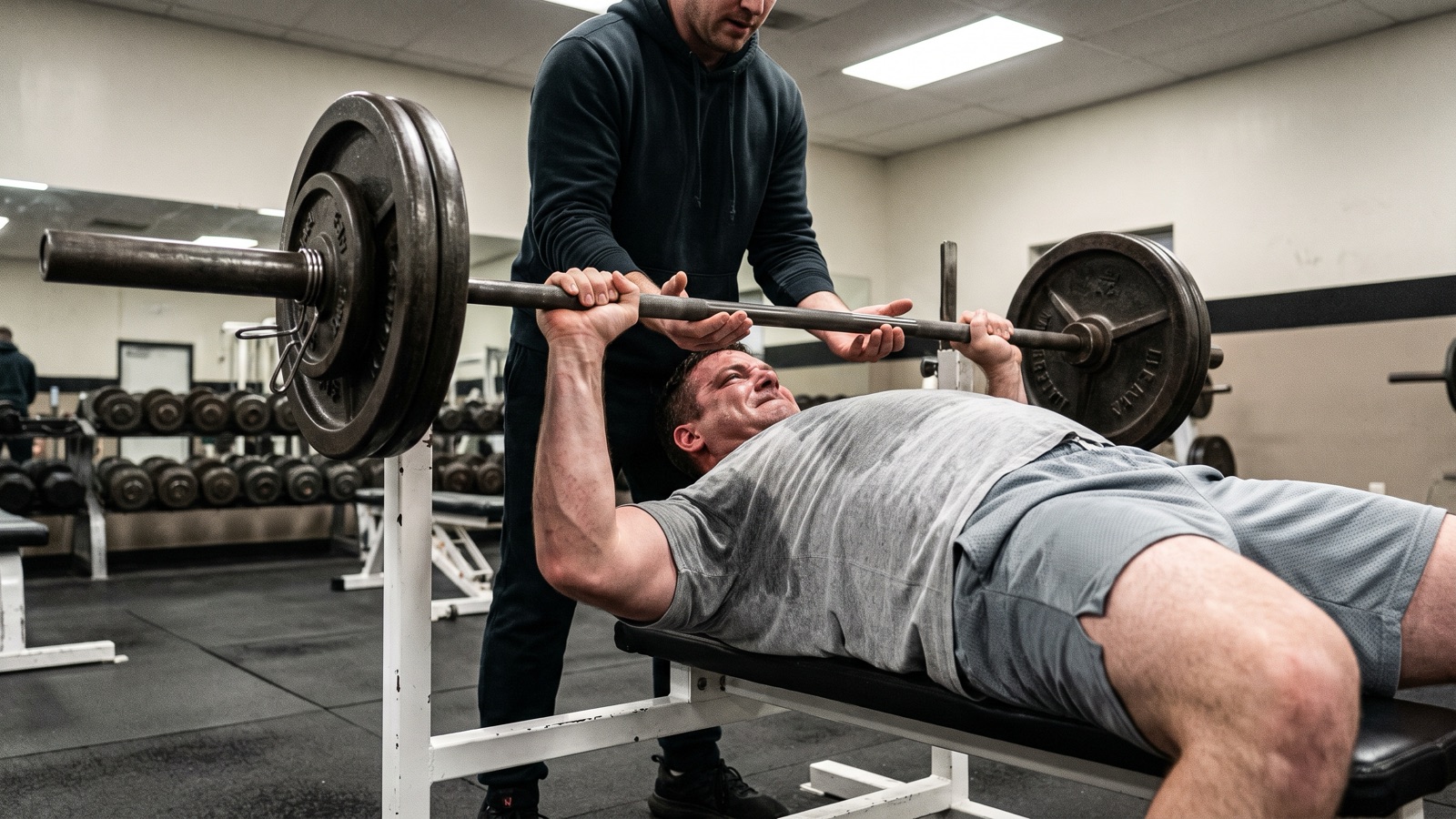
The first half of the rule is solid physiology. The second half, the part that tells you what to do in the gym, has been tested directly. It did not hold up.
What the Research Actually Found
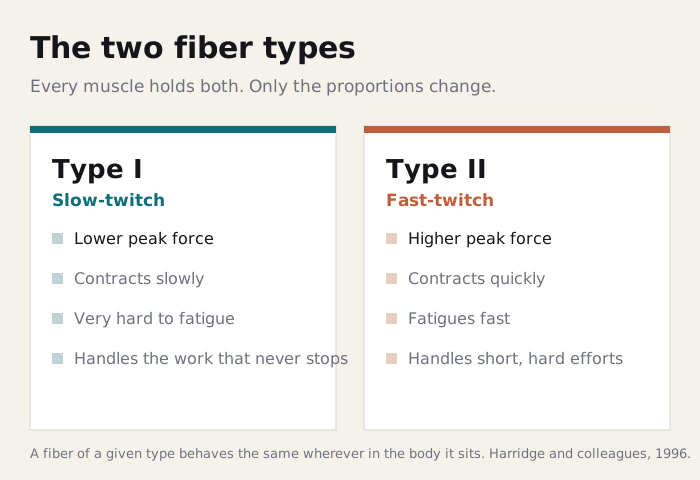
Every muscle you own is a mix of two broad fiber types. Slow-twitch fibers, called type I, contract gently, resist fatigue and handle the work that never really stops. Fast-twitch fibers, type II, contract harder and faster and give up sooner. Both types sit inside every muscle, in different proportions.
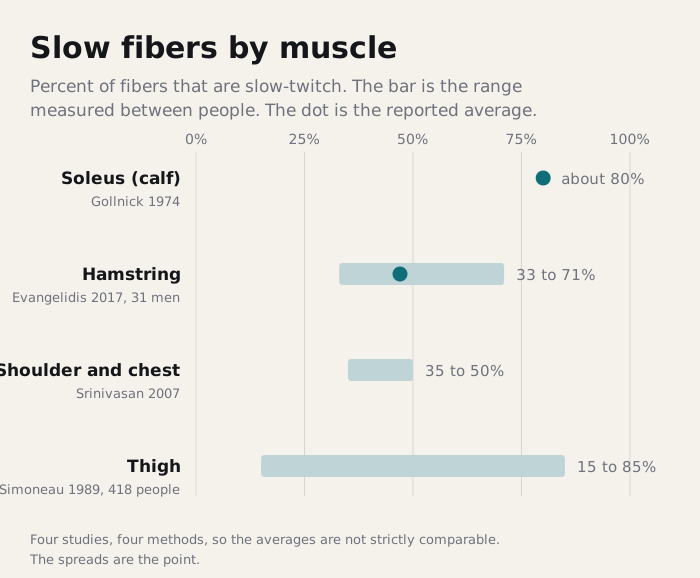
Those proportions are genuinely different from place to place. The soleus, the flat muscle that makes up most of your lower calf, runs around 80 percent slow fibers.[1] It holds your body upright for every step you take, so a fatigue-resistant build makes sense.
The pattern has a nuance worth knowing. When one lab biopsied the long head of the biceps femoris in 31 young men, the biggest hamstring muscle came out at 47 percent slow fibers, with individuals running from 33 to 71 percent. That is not a fast muscle. It is a mixed one, and the researchers put the point in the title of the paper.[2] A separate study sectioned 14 muscles crossing the shoulder and found that 12 of them averaged between 35 and 50 percent slow fibers.[3] Chest and back are mixed too.
There is also a detail that quietly undercuts the whole idea of muscle-specific training. When researchers pulled single fibers out of the calf, the thigh and the triceps of the same seven men and tested them one at a time, fibers of the same type behaved almost identically no matter which muscle they came from.[4] A slow fiber in your calf is not a different machine from a slow fiber in your chest. There are simply more of them.
The Part That Does Not Survive Testing
If fiber type set the correct rep range, the calf is where you would see it most clearly. The soleus is about as slow-twitch as human muscle gets, and it sits directly under the gastrocnemius, which is closer to half and half.
In 2020 a group ran exactly that experiment. Twenty-six untrained men trained calves twice a week for eight weeks, one leg on heavy sets of six to ten reps and the other leg on light sets of twenty to thirty, every set taken to failure. Same person, same food, same sleep, one leg each way.
The heavy leg's soleus gained 1.3 mm of thickness. The light leg's gained 1.5 mm. The gap between the two was 0.2 mm, with an interval running from minus 0.3 to plus 0.7 mm, which is another way of saying the study could not tell the legs apart. The gastrocnemius did the same thing. Strength rose by an identical 15 N·m on both sides.[5]
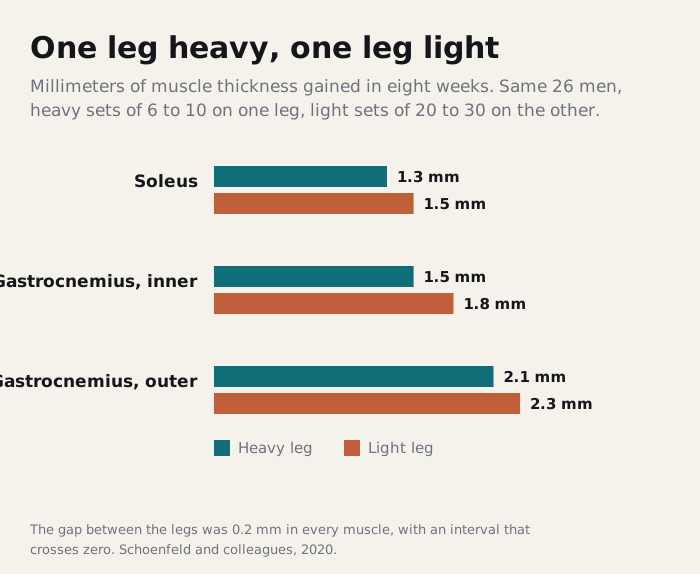
The most slow-twitch muscle in the body did not prefer the light sets. Nothing preferred anything.
That result is not a one-off. In a separate trial, 49 trained men spent 12 weeks lifting either 30 to 50 percent of their maximum for 20 to 25 reps or 75 to 90 percent for 8 to 12 reps, all of it to failure. Biopsies at the end showed that type I fibers and type II fibers had both grown, and neither group grew more than the other.[6] When a review pooled every study that had measured fibers under different loads, the authors concluded there was not enough evidence to call fiber growth load-specific at all.[7]
Why The Rule Falls Apart Before You Use It
Suppose the rule did work. You would still need to know your own numbers, and you do not.
The largest survey of this took a biopsy from the same thigh muscle in 418 people. The proportion of slow fibers ran from 15 percent to 85 percent.[8] One muscle, one sampling site, and a spread several times wider than any gap between the muscle averages above. The person beside you doing calf raises may have a genuinely fast calf and a thigh slower than your calf.
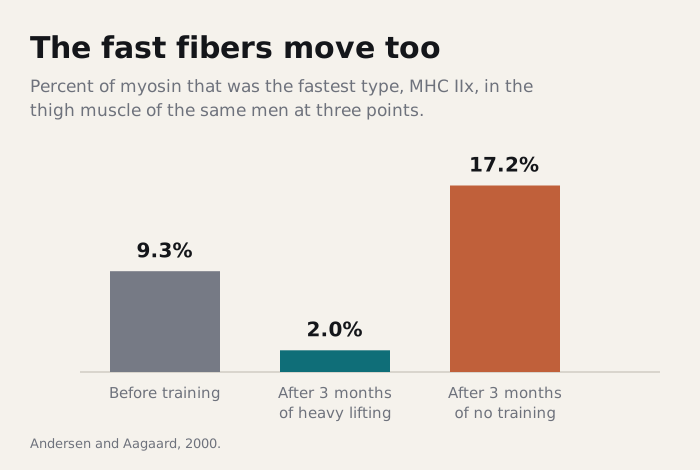
Your own numbers also move. Three months of heavy lifting cut the fastest myosin protein, MHC IIx, from 9.3 percent to 2.0 percent in one group of men. Three months of sitting still pushed it back up to 17.2 percent, higher than where they had started.[9] The composition you would be building a program around is partly a product of the program.
What It Looks Like in Practice
None of this says rep ranges do not matter. It says the muscle does not choose them for you.
- Take the set close to failure. That is the one thing every study here held constant, and it is what decided the outcome. It matters far more than the number on the dumbbell.
- Use heavy work when the goal is strength. Load stops mattering for size once sets go to failure, but it still matters for a maximum. The bench press number moved further in the heavy group of that 12-week trial.[6]
- Pick the rep range the exercise can deliver. A standing calf raise loaded for six reps is hard to control and easy to bounce through on the tendon. That is a mechanics problem rather than a fiber problem, and it is a real reason higher reps often work better on calves.
- Vary it because you can, not because a chart told you to. Both ranges grow both fiber types, so use the one you can keep doing well.

If your calves have not grown, the most likely reason is not that you picked the wrong rep range. It is that no calf set ever got close to the point where finishing it was genuinely in doubt. The same logic runs through the research on how many sets a muscle actually needs each week: what you do inside the set decides more than the label you put on it.
References
- Gollnick PD, Sjödin B, Karlsson J, Jansson E, Saltin B. Human soleus muscle: a comparison of fiber composition and enzyme activities with other leg muscles. Pflugers Arch. 1974;348(3):247-255. doi:10.1007/BF00587415
- Evangelidis PE, Massey GJ, Ferguson RA, Wheeler PC, Pain MTG, Folland JP. The functional significance of hamstrings composition: is it really a "fast" muscle group? Scand J Med Sci Sports. 2017;27(11):1181-1189. doi:10.1111/sms.12786
- Srinivasan RC, Lungren MP, Langenderfer JE, Hughes RE. Fiber type composition and maximum shortening velocity of muscles crossing the human shoulder. Clin Anat. 2007;20(2):144-149. doi:10.1002/ca.20349
- Harridge SD, Bottinelli R, Canepari M, et al. Whole-muscle and single-fibre contractile properties and myosin heavy chain isoforms in humans. Pflugers Arch. 1996;432(5):913-920. doi:10.1007/s004240050215
- Schoenfeld BJ, Vigotsky AD, Grgic J, et al. Do the anatomical and physiological properties of a muscle determine its adaptive response to different loading protocols? Physiol Rep. 2020;8(9):e14427. doi:10.14814/phy2.14427
- Morton RW, Oikawa SY, Wavell CG, et al. Neither load nor systemic hormones determine resistance training-mediated hypertrophy or strength gains in resistance-trained young men. J Appl Physiol. 2016;121(1):129-138. doi:10.1152/japplphysiol.00154.2016
- Grgic J, Schoenfeld BJ. Are the hypertrophic adaptations to high and low-load resistance training muscle fiber type specific? Front Physiol. 2018;9:402. doi:10.3389/fphys.2018.00402
- Simoneau JA, Bouchard C. Human variation in skeletal muscle fiber-type proportion and enzyme activities. Am J Physiol. 1989;257(4 Pt 1):E567-E572. doi:10.1152/ajpendo.1989.257.4.E567
- Andersen JL, Aagaard P. Myosin heavy chain IIX overshoot in human skeletal muscle. Muscle Nerve. 2000;23(7):1095-1104. doi:10.1002/1097-4598(200007)23:7<1095::AID-MUS13>3.0.CO;2-O