Shoulder Health · 30-Day Test
I Trained Rotational Strength for 30 Days. My Shoulders Have Never Felt This Good.
Steel mace training is all over social media. Nobody explains why it actually works. I spent a month finding out.

Steel mace training is all over social media. Nobody explains why it actually works. I spent a month finding out.
Every exercise in my training split moved in a straight line. Bench press goes up and down. Rows pull forward and back. Overhead press travels vertical. Curls go up. Lateral raises go out. Twenty-two exercises across four training days, and not one asked my shoulders to rotate through a circle.
I counted because I was curious. The number was zero.
Pick any popular training program. Push, pull, legs. Upper, lower. Bro split. Count the exercises. Nearly all of them travel along a single plane. Bench press: sagittal. Overhead press: sagittal. Rows: sagittal. Lateral raises: frontal. Curls: sagittal again.
The transverse plane, where rotation lives, barely shows up. Maybe a cable woodchop. Maybe a landmine rotation. In most programs, that is it.
This matters because the shoulder is not a hinge. It is a ball in a socket with the most rotational freedom of any joint in the body. The glenohumeral joint can move in six degrees of freedom, and we train it in two.[1]

The rotator cuff is a group of four muscles: supraspinatus, infraspinatus, teres minor, subscapularis. Their job is not to move your arm. Their job is to keep the ball of the humerus seated in the socket while the bigger muscles move it. When the prime movers get progressively stronger and the stabilizers do not, the joint starts compensating.
That compensation is familiar to anyone who has pressed for a few years. Clicking during warmup sets. Stiffness after overhead work. A dull ache that shows up on rest days and fades just enough to ignore.
The standard fix is face pulls, band pull-aparts, and shoulder circles. Those are better than nothing. None of them involve progressive load through a full rotational arc.
I bought the EZ-MACE V2 PRO on a Monday. It showed up Wednesday. The bare handle weighs 0.9 kg, which is light enough to start with zero plates and focus purely on the movement pattern.
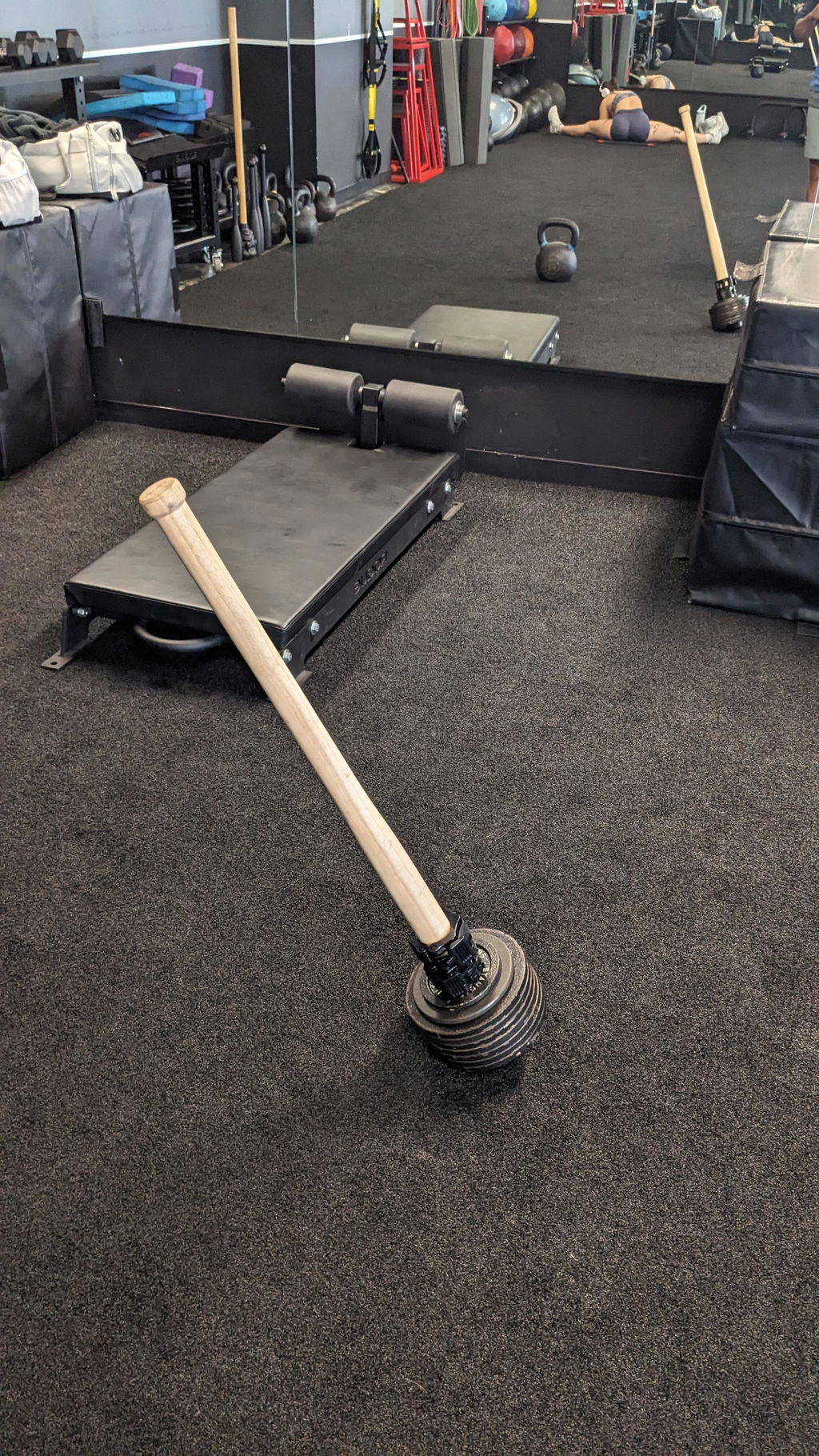
Added 10 minutes of mace work after every training session. Basic pendulums, figure eights, and partial 360-degree swings with no plates loaded. The movements felt completely foreign. Muscles along the back of my shoulder and between my shoulder blades were firing in patterns that pressing and pulling had never touched. My forearms were sore the following morning, and they do not get sore from deadlifts.
Added a 2.5 lb plate. Small on paper, noticeable in practice. My overhead pressing warmups started to feel different. The shoulders moved through the full arc without the tightness I had been ignoring at the top of every rep. Two training partners asked if I had been stretching more. I had not.
Another 2.5 lb plate, five total pounds on the mace. The shoulder clicking during bench press warmups stopped. Not reduced. Stopped. My bench numbers had not moved, but the bar path felt cleaner and the bottom of the rep felt more stable. Incline pressing, which had aggravated my front delt for months, was suddenly comfortable.
Ten pounds on the mace. Full 360-degree swings with continuous rotation behind the head and over the top. The mace moved like an extension of my arms instead of a weight I was fighting to control. Shoulder mobility felt better than it had in years. Getting into a low bar squat position, something that used to require five minutes of band work, took thirty seconds.

This is one person's experience over one month. An anecdote is not a study. What I can report is what changed for me. The clicking stopped, overhead mobility improved, and pressing felt smoother. Whether the mace caused those changes or four weeks of any new stimulus would have done the same is a question I cannot answer from inside the experiment.
The posterior rotator cuff, specifically infraspinatus and teres minor, resists internal rotation of the shoulder. These two muscles control what happens when your arm rolls inward under load. Every pressing movement applies internal rotation force. If the posterior cuff is too weak relative to the internal rotators, the humeral head migrates forward in the socket.
Studies on overhead athletes have consistently shown that the ratio of external to internal rotation strength matters. Research published in the American Journal of Sports Medicine found that shoulder injuries in throwing athletes correlated with deficits in external rotation strength, not absolute strength in any single direction.[2] The posterior cuff needs to keep pace with the anterior muscles, and most gym programs do not train it proportionally.
During a circular mace swing, the load vector changes direction continuously. At the top of the arc, the weight pulls the arm into extension. As the mace passes behind the head, it creates an external rotation force. Coming back over, it shifts to flexion and internal rotation. The cuff cannot predict where force is coming from next, so all four muscles stay active through the full movement.
This is different from band external rotations, where the load direction stays constant and the cuff fires in one predictable pattern. It is also different from face pulls, which load the posterior cuff in one arc and then stop.

A 2013 systematic review in the British Journal of Sports Medicine examined exercise interventions for rotator cuff disease and found that progressive loading of the rotator cuff, especially eccentric loading, produced clinically meaningful improvements in pain and function.[3] The mace delivers both concentric and eccentric rotational loading in every repetition.
Face pulls train the posterior cuff in one direction. Mace swings train it in all of them.
Steel mace training is not new. Indian clubs and gadas go back centuries. But the modern equipment market has a problem: progression requires buying multiple tools.
Onnit sells fixed-weight steel maces. Their 10 lb version costs $69.95. The 15 lb runs $89.95. A 20 lb mace is $119.95. The 25 lb is $139.95. To progress from a beginner weight to an intermediate one, you need all four. That is $419.80 for tools you outgrow one at a time, and they pile up in the corner of your gym.
Amazon is cheaper but worse. Cast iron maces in the $30-50 range show up with rough welds, uneven weight distribution, and handles that flex under rotational load. Browse the reviews and you will find photos of bent handles and cracked head welds. For a tool you are swinging behind your head, that is not a savings worth celebrating.
The EZ-MACE V2 is one handle that takes the weight plates you already own. Load a 2.5 lb plate this week. Add another next week. A 5 lb plate the week after that. Same handle, infinite progression, and you never outgrow it.


Your shoulder was built to rotate. Your training program never asks it to.
The mace gets attention for shoulder work, and that is what brought me to it. But the offset load creates three additional training effects that have nothing to do with the rotator cuff.
Holding a mace with weight on one end forces the core to resist the rotational pull. This is the same principle behind Pallof presses, but with a longer moment arm and a dynamic load path. A 10 lb plate on a 40-inch handle creates more rotational demand on the obliques than a much heavier symmetric barbell. Single-arm overhead carries with the mace make anti-rotation planks feel like warmups.
The 40-inch handle with weight concentrated at one end is a constant grip challenge. Your hands have to resist the mace's tendency to roll and slide, which trains grip endurance in a way that barbells do not. Research from the Prospective Urban Rural Epidemiology (PURE) study, covering 139,691 adults in 17 countries, found that grip strength was a stronger predictor of cardiovascular mortality than systolic blood pressure.[4] Grip is not a vanity metric.
Circular movements train wrist extensors and flexors through their full range under load. Both directions get work: the overhand portion loads the extensors, and the underhand return loads the flexors. For anyone who types all day and then picks up a barbell, this is relevant. Wrist strength built through full-range rotation is different from what you get from static barbell holds.

The mace is a rotational tool for the entire body. Calling it a shoulder tool undersells it the same way calling a barbell a leg tool would undersell the barbell.
Kensui's EZ-MACE V2 is a plate-loaded handle designed for mace and club-style training. It comes in two versions: the PRO uses a Malaysian rubber wood handle and weighs 0.9 kg empty. The MAX uses a steel handle with powder coat and weighs 2.3 kg empty. Both have a 40mm diameter grip and 30cm of plate-loading space.
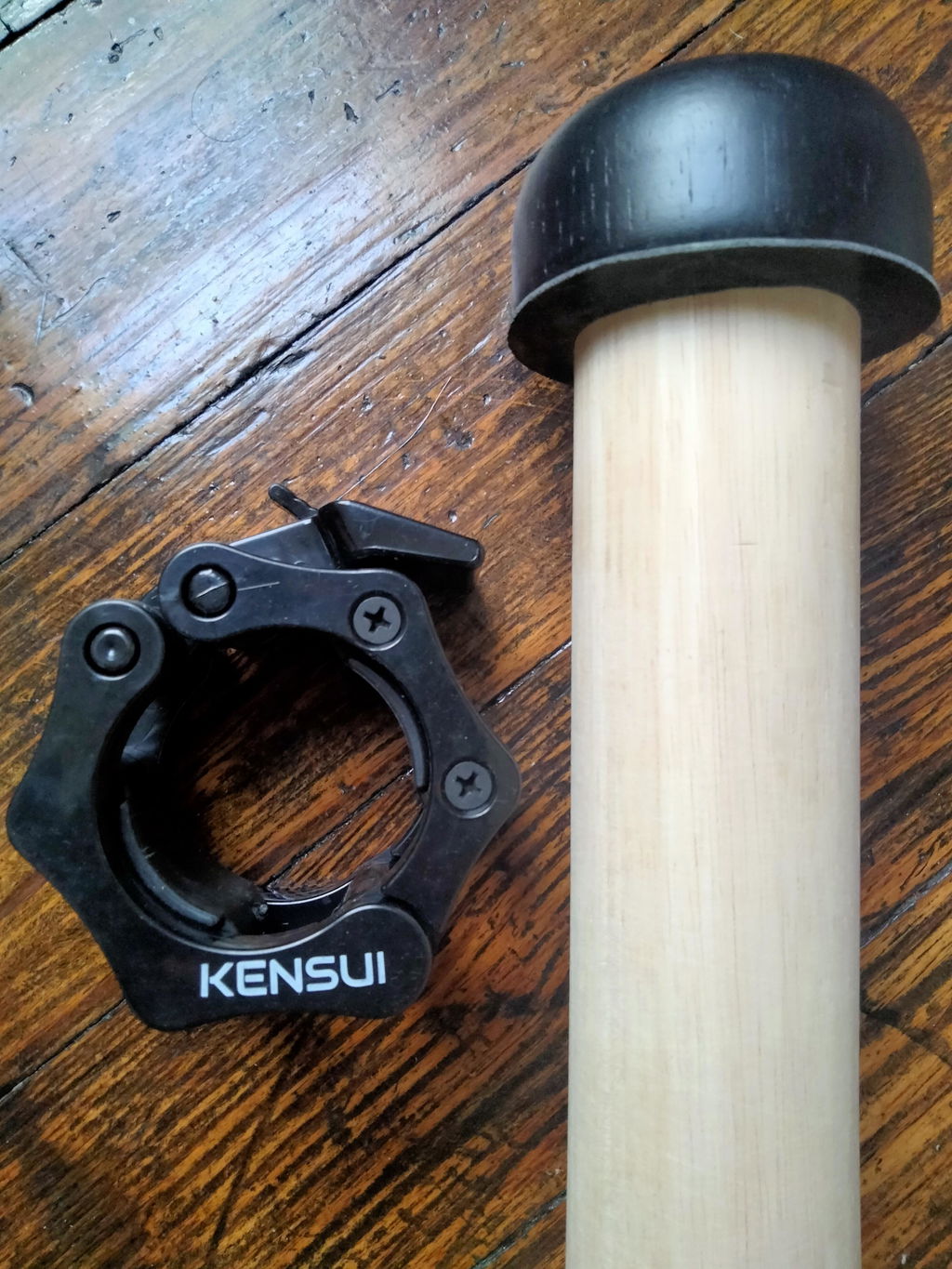

The loading post accepts Olympic (2") plates. Whatever your smallest plate weighs is the size of your next jump. If you own 1.25 lb change plates, you can progress in 1.25 lb increments. Try doing that with a fixed-weight mace collection.
The total length is 40 inches (103 cm), which is long enough for full 360-degree swings behind the back but short enough to use indoors without hitting the ceiling. Worth mentioning: the PRO at $75 costs about $5 more than a single Onnit 10 lb fixed mace at $69.95, and it covers every weight you will ever need.

You press. You pull. You squat. You hinge. But when was the last time you asked your shoulders to rotate through a full circle under load? One plane of movement has been absent from your program for years. The stabilizers that live there are still waiting.
Get the EZ-MACE$75 PRO (wood) · $149 MAX (steel) · Uses the plates you own

Product prices, specifications, and review counts were checked against kensui.com on July 30, 2026 and can change. Onnit pricing was checked on onnit.com the same day. This article is general training information and is not medical advice. If you have a shoulder injury, consult a qualified professional before beginning rotational training.

New training studies broken down in plain English, gear we actually tested, and what it all changes about your week in the gym.
By signing up you agree to receive email from Science Meets Gym. No spam, and you can unsubscribe at any time.
