Your Neck Hurts Because You Keep Stretching It Instead of Training It
Stretching changes how your neck feels. Loading it changes what your neck can handle. Those are not the same thing, and the research is fairly clear about which one lasts.
Chris Bennett
July 27, 2026 · 9 min read
Loading the neck directly, with plates you can add to. The same principle you already apply to every other muscle.
01
The Move Almost Everybody Makes
Watch an office at four in the afternoon. Heads tilt to one side. Shoulders roll backward. Somebody digs a thumb into the top of their trap and holds it there.
Now watch a gym at seven. Same picture between sets, just with better posture.
Two very different groups of people are treating the exact same feeling: a tight, hot band running across the top of the shoulders and up the back of the neck. And both groups reach for the exact same fix. They stretch it.
That fix works. Which is the whole problem. It works just long enough that almost nobody goes looking for a better one.
The option almost nobody takes. A room full of ways to add weight, and none of it ever gets pointed at the neck.
Your neck is probably the only muscle group you have never once tried to make stronger. You train your legs. You train your back. You have opinions about rear delts. Meanwhile the muscles holding your head up all day get a slow circle and a thumb.
02
Why the Relief Keeps Wearing Off
Here is what a stretch actually does to tissue.
For a long time the assumption was mechanical. Pull on a muscle enough and it gets longer, the way a rubber band does. A 2010 review in Physical Therapy went through the evidence for that idea and found it did not hold up.[3] The muscle does not meaningfully lengthen. What changes is your tolerance to the position. Your nervous system stops complaining as loudly at the same joint angle.
That is a real effect and it is not worthless. Feeling better matters.
Stretching turns down the alarm. It does not change the load that set the alarm off.
Your neck holds your head up all day, in whatever position you leave it, whether that is over a keyboard or under a bar. If the tissue doing that job is not strong enough for it, a quieter alarm does not make the job any easier. The demand is still waiting for you at four o'clock tomorrow.
Strength is the other lever. And unlike tolerance, it is a physical change to what the tissue can do.
A neck curl against a weight you picked. The load is a number, which is the part a stretch can never give you.03
Somebody Ran This Exact Comparison
In 2003, JAMA published a trial that put the two approaches head to head.[1]
Researchers recruited 180 women with chronic neck pain. All of them were office workers, aged 25 to 53. They were split into three groups of 60 and followed for a full year.
The first group did neck strength training. The second did neck endurance training. The third group, the control, was given the advice most people with a sore neck get: aerobic exercise and stretching.
After 12 months, this is what happened to neck strength.
GroupFlexionRotationExtension
Strength trainingResistance work, progressed over time
+110%
+76%
+69%
Endurance trainingHead lifts, higher reps
+28%
+29%
+16%
Stretching and cardioThe standard advice, control group
+10%
+10%
+7%
Change in maximal isometric neck strength at 12 months, by group. Ylinen et al., JAMA 2003.
Neck pain and disability both fell in the two training groups compared with the control (P<.001). The authors were blunt about the comparison. Stretching and aerobic exercise are what people with chronic neck pain are usually told to do, and both turned out to be far less effective than strength training.
Look at that bottom row one more time. Those 60 women did not slack off. They spent a year doing precisely what most people reading this are doing right now, and their necks finished about 10% stronger.
Progressive Load, Without a Machine
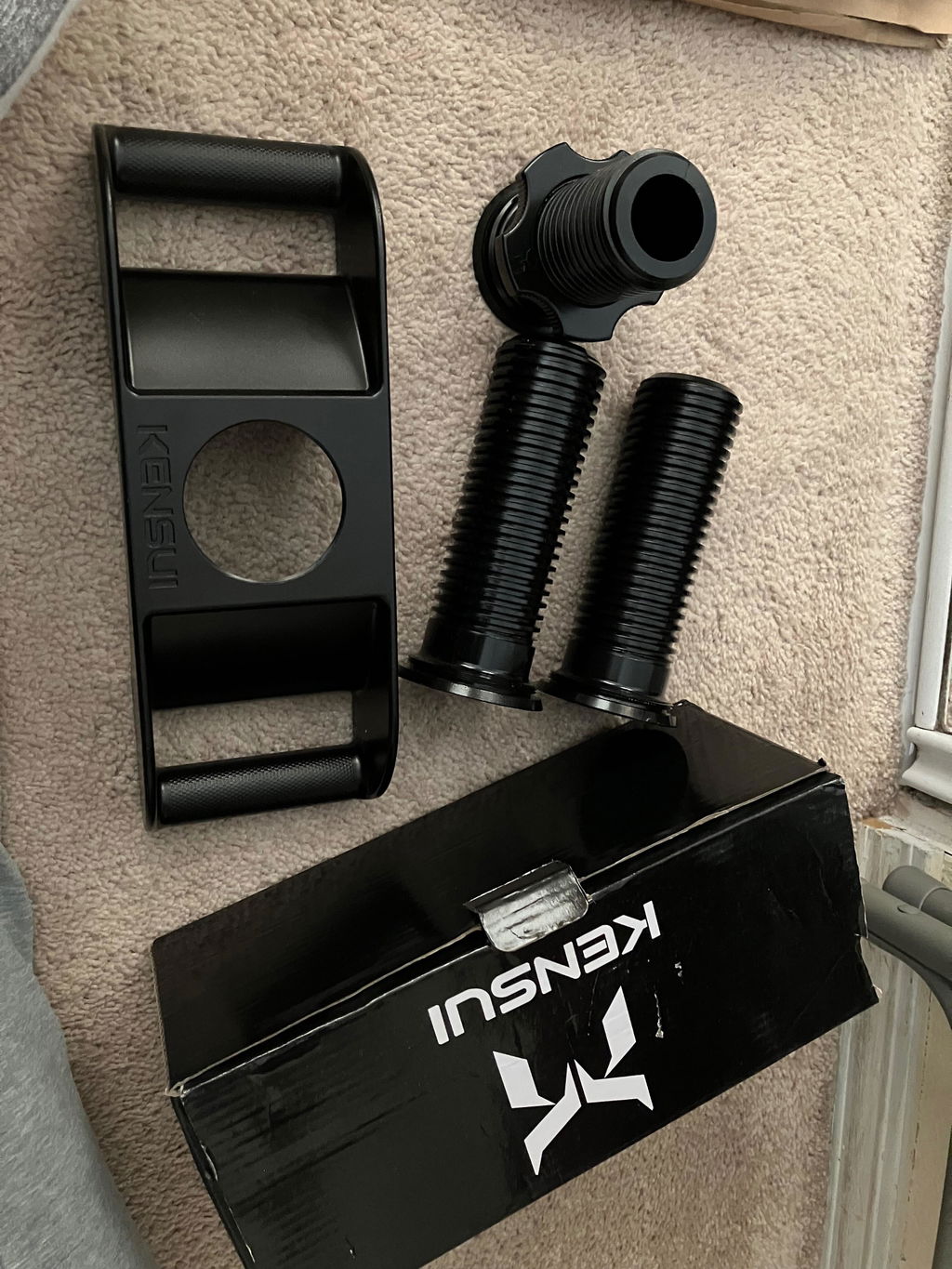
The EZ-NECK is a plate loaded neck trainer. Thread on the plates you already own, hold the knurled handles, and add weight in small steps as you get stronger. PRO holds up to 100 lbs and starts at $49.
The obvious objection is time. Nobody with a sore neck is excited about adding a 45 minute program to their week.
A 2011 trial in Pain tested how small a dose could still do something.[2] Researchers recruited 198 people who worked at least 30 hours a week and had frequent neck and shoulder pain. One group did progressive resistance training for 12 minutes a day. Another did the same training for just 2 minutes a day. Both trained five days a week for 10 weeks. A third group received general health information instead.
Loaded side flexion. The direction changes, the principle does not. Pick a weight, then make it heavier.
Compared with the control, the 2 minute group improved on every measure. Pain dropped 1.4 points on a 10 point scale. Tenderness dropped 4.2 points on a 32 point scale. Strength rose 2.0 Nm.
Two minutes, five days a week, for ten weeks.
2 min
a day of training
5 days
a week
10 weeks
start to finish
The smallest dose tested in Andersen et al., Pain 2011. It still beat the control group on pain, tenderness and strength.
The word doing the heavy lifting there is progressive. The training got harder over time. That is the entire mechanism. Tissue adapts to a demand that keeps climbing, and it stops adapting the second the demand stops climbing.
05
What Each One Is Actually For
This is not an argument against stretching. Stretch as much as you like. It is an argument that stretching is the wrong tool for this particular job, and that most people are using it as though it were the only tool in the box.
What Stretching Does
Raises your tolerance to a position
Feels better within seconds
Costs nothing and needs no equipment
Leaves the tissue's capacity roughly where it was
Has to be repeated to keep the effect
What Loading Does
Builds measurable strength in the tissue
Takes weeks, not seconds, to show up
Needs a way to add resistance over time
Raises the ceiling, so an ordinary day sits further below it
The gains stay with far less upkeep
One manages the symptom in the moment. The other changes the thing producing the symptom. Doing both is fine. Doing only the first one for fifteen years is how you end up here.
06
Where the Evidence Gets Messier
We should be straight about the limits, because this is a page about pain and the honest version is more useful than the clean one.
The findings are not unanimous
A 2008 one year trial in Clinical Rehabilitation compared strength training plus stretching against stretching alone in 101 people with chronic neck pain.[4] Both groups improved a lot. Neither pulled clearly ahead of the other. Worth knowing: adherence was low across both arms, averaging roughly one session a week. Training people do not actually do tends not to separate from anything.
Athletes ask a different version of the question, and that answer is messy too. A 2025 systematic review in Sports Medicine pooled 60 studies on what drives head acceleration during soccer headers.[5] Some of the evidence linked greater neck strength to lower head acceleration. Some of it did not, and conventional neck strengthening on its own did not reliably produce the effect.
So here is the careful version. A stronger neck is a sensible thing to build, and the strongest evidence for it sits in office workers with ordinary chronic neck pain. It is not protective equipment. We are not claiming it prevents concussions, and anyone who tells you a neck program does is going past what the research supports.
This is not medical advice. If you have an existing neck injury, numbness or tingling running down an arm, headaches, or pain that has not shifted in months, talk to a clinician before you load anything.
07
The Part Nobody Ever Solves
Say you buy the argument. You would rather train the neck than keep stretching it. Now try to actually do that.
Your neck is one of the only muscle groups with no obvious way to add weight. Pushing on your own head with your hand works right up until your hand becomes the weak link, and you have no way of knowing whether today was harder than last Tuesday. Lying on a bench and lifting your head is a fixed load you outgrow in about three weeks. The old strap and chain rigs solve part of the problem, and they pull in one direction only.
Go back to the word from the Pain trial. Progressive. Without a way to add small amounts of weight over time, you do not have a training program. You have a warm up.
The whole point of a plate loaded tool is that next week can be heavier than this week, by an amount you choose.08
What the EZ-NECK Actually Is
It is a plate loader for your head. That is the honest one line description.
A padded bracket sits against your skull. The post takes 2-inch Olympic plates, and a spin lock collar holds them in place. You grip the knurled handles, and you do neck curls, extensions and side flexion against a load you picked. Adding 2.5 lbs takes about ten seconds and costs nothing, because the plates are the ones already on your rack. If yours are the standard 1-inch size, Kensui sells adapters for those separately.
The four parts that matter: padding against the head, a spin lock collar for the plates, and a knurled handle on each side.
It comes in two versions, and the difference is material and capacity.
PRO is nylon fiberglass and rated to 100 lbs. MAX is aluminum alloy and rated to 200 lbs.
For almost anyone starting from zero, the PRO is the right call. A 100 lb ceiling is more neck strength than you are going to need for a very long time, and $49 is a low price to find out whether you will stick with it.
09
Where to Start
Kensui makes four things that load the neck. They are not four versions of the same product, they are four different price points for different levels of commitment.
EZ-NECK LITE$17.95The cheapest possible way to find out whether you will actually do this twice a week.
EZ-NECK PRO$49.00Nylon fiberglass, rated to 100 lbs. The one most people should buy.
EZ-NECK MAX$129.00Aluminum alloy, rated to 200 lbs. Buy this if you already know you will outgrow the PRO.
EZ-HELM$199.00A plate loaded helmet. The premium option, and it leaves your hands free.
Two minutes of loaded work, a few days a week, using plates that are already sitting in the corner of the room.
Whatever you pick, the principle from the research is the same one that governs every other lift you do. Start light enough to be boring. Add a little. Keep adding.
Stretching will still feel good at four in the afternoon. It just will not be the only thing you have.
Start Training the Neck You Have Been Stretching
The Kensui EZ-NECK loads neck curls, extensions and side flexion with plates you already own, so the weight can actually go up over time.
Ylinen J, Takala EP, Nykänen M, Häkkinen A, Mälkiä E, Pohjolainen T, Karppi SL, Kautiainen H, Airaksinen O. Active neck muscle training in the treatment of chronic neck pain in women: a randomized controlled trial.JAMA. 2003;289(19):2509-2516. PubMed 12759322
Andersen LL, Saervoll CA, Mortensen OS, Poulsen OM, Hannerz H, Zebis MK. Effectiveness of small daily amounts of progressive resistance training for frequent neck/shoulder pain: randomised controlled trial.Pain. 2011;152(2):440-446. PubMed 21177034
Weppler CH, Magnusson SP. Increasing muscle extensibility: a matter of increasing length or modifying sensation?Physical Therapy. 2010;90(3):438-449. PubMed 20075147
Häkkinen A, Kautiainen H, Hannonen P, Ylinen J. Strength training and stretching versus stretching only in the treatment of patients with chronic neck pain: a randomized one-year follow-up study.Clinical Rehabilitation. 2008;22(7):592-600. PubMed 18586810
Blyth R, Farrell G, Zoellner A, Ahmed OH, Bussey M, Galea O, Sole G. What factors influence head acceleration during a purposeful header in soccer players? A systematic review.Sports Medicine. 2025. PubMed 40272776
Nothing here is medical advice, and nothing here is intended to diagnose or treat any condition. Prices and specifications were confirmed on kensui.com on July 28, 2026.
Chris Bennett is a house byline for Science Meets Gym. Gear published under it is bought at retail and trained with before anything gets a verdict, and every claim about training outcomes is checked against the published research first.
Science Meets Gym earns a commission when you buy through some of the links on this page. It never changes which products we recommend or how they score.
Weekly
Want The Research Without The Hype? Start Here.
New training studies broken down in plain English, gear we actually tested, and what it all changes about your week in the gym.
By signing up you agree to receive email from Science Meets Gym. No spam, and you can unsubscribe at any time.