TRAINING · 6 MIN READ
You Are Not Too Weak For a Pull-Up. You're Training The Wrong Half.
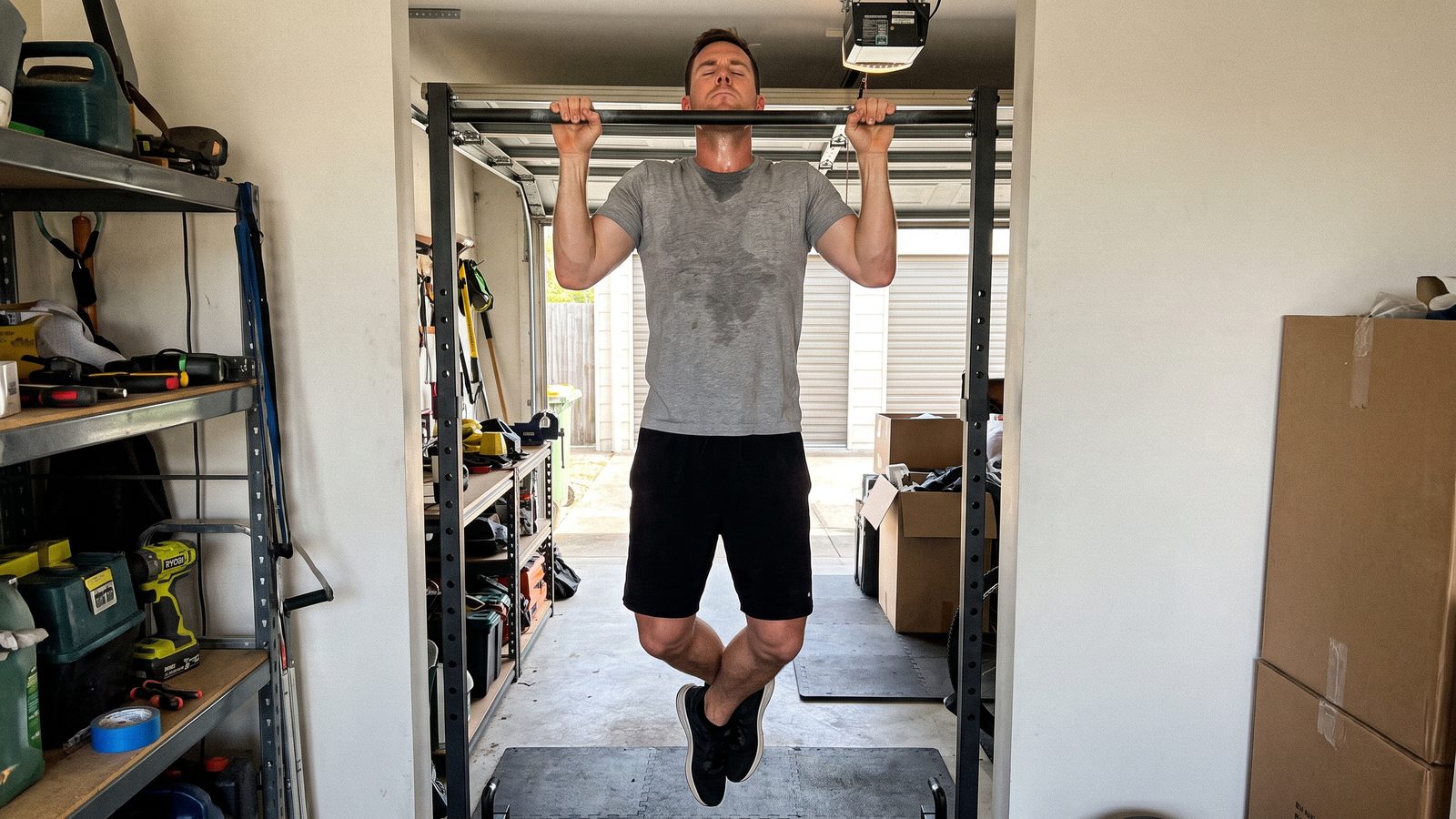
Pooled across 335 studies, people handled about 41 percent more weight lowering it than lifting it. That gap is why a pull-up you cannot do yet is still trainable today.

The Claim
You stand under the bar, you pull, and nothing happens. Or you get halfway, stall, and hang there until your grip gives out. The rep feels like a wall you have to be strong enough to walk through before you are allowed to start.
Most advice agrees with that framing. Do lat pulldowns, do rows, loop a band under your feet, and one day you will be strong enough to try the real thing.
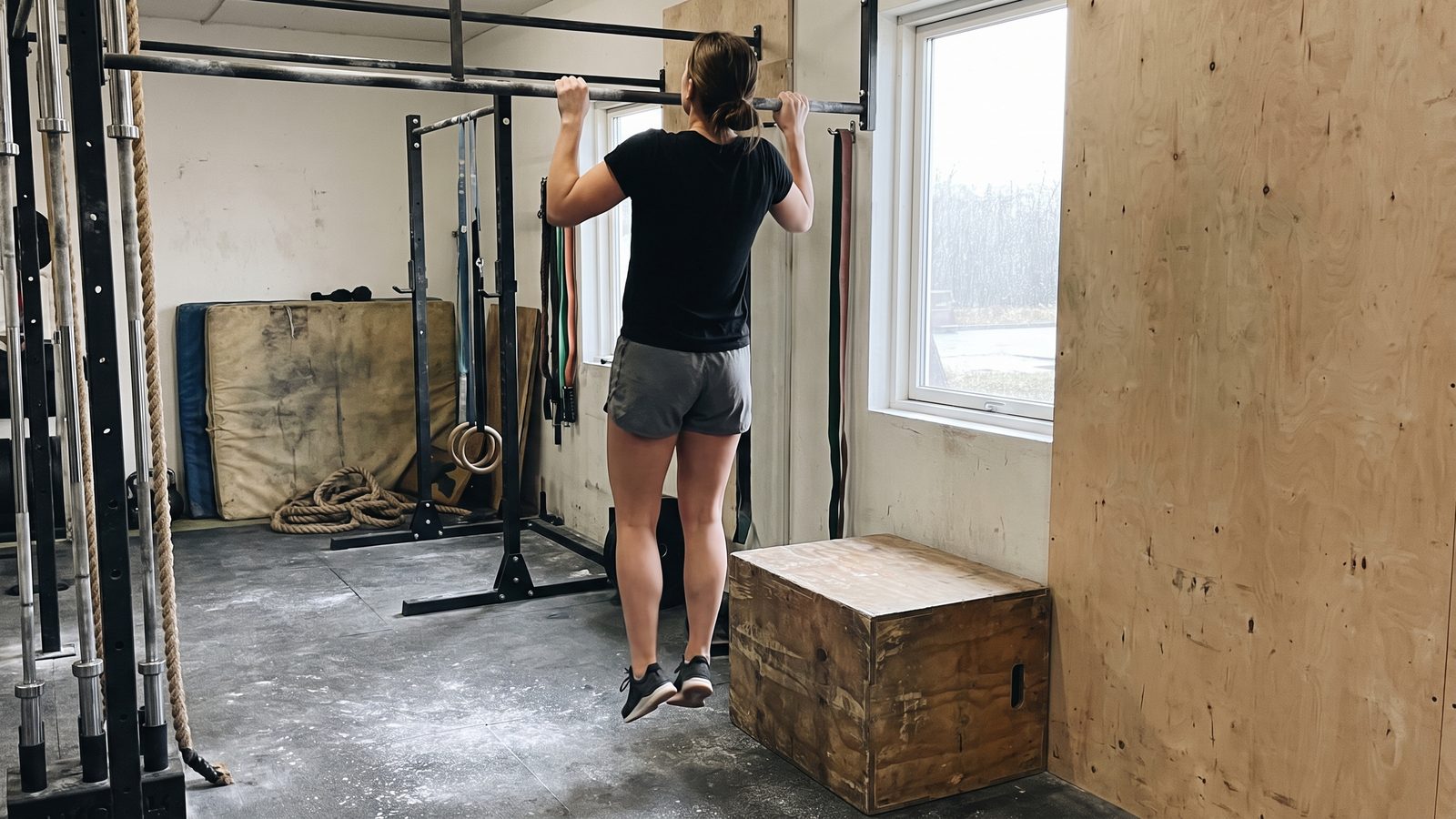
There is a faster way in, and it costs nothing. Jump or step to the top of the bar so your chin is already over it. Then fight the way down, as slowly as you can hold it. That is a negative, and it works for a reason most lifters never hear: you do not have one strength. You have two.
What the Research Actually Found
Every rep has two halves. On the way up the muscle shortens, which is the concentric half. On the way down it lengthens while still under load, which is the eccentric half. Those two halves do not have the same ceiling.
In 2023, a team pooled every measurement of both they could find: 1,516 comparisons drawn from 12,546 people across 335 studies. The average person handled 1.41 times more weight lowering than lifting.[1] Older adults sat higher at 1.62. Women came in at 1.47 against 1.38 for men.
Those figures come mostly from isokinetic machines, which are not a barbell, so the number is worth checking on real lifts. A 2007 study ran ten trained men and ten trained women through six standard exercises and measured both maxes on each. In the men the gap ran from 27 percent on the leg curl to 49 percent on the military press. Bench press landed at 40 percent, leg press at 44.[2]
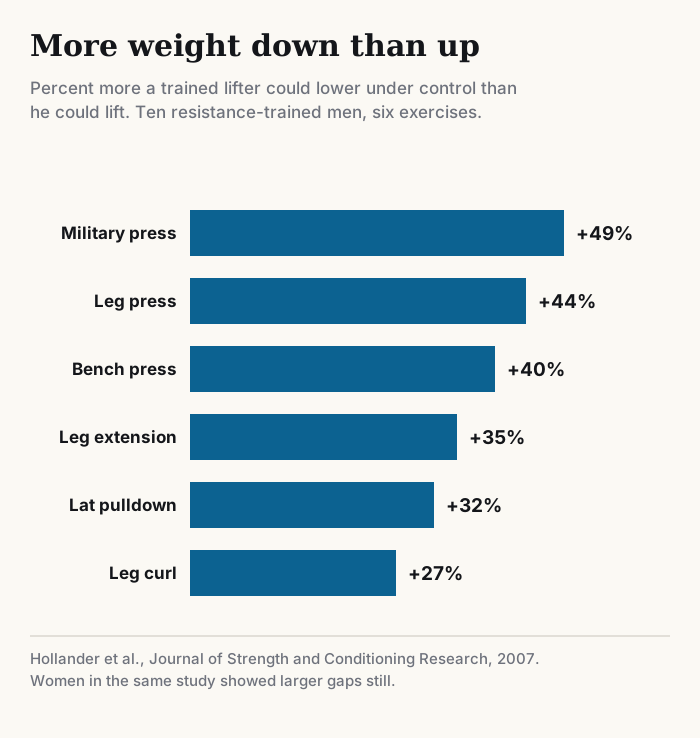
Read that as an inventory rather than trivia. If you bench 185 pounds, the bar you can lower under control is somewhere near 260. That strength is already yours. Nothing in a normal session ever asks for it, because the weight on the bar gets picked by what you can press.
Why the Gap Exists
Two things happen when a working muscle gets pulled longer instead of shorter.
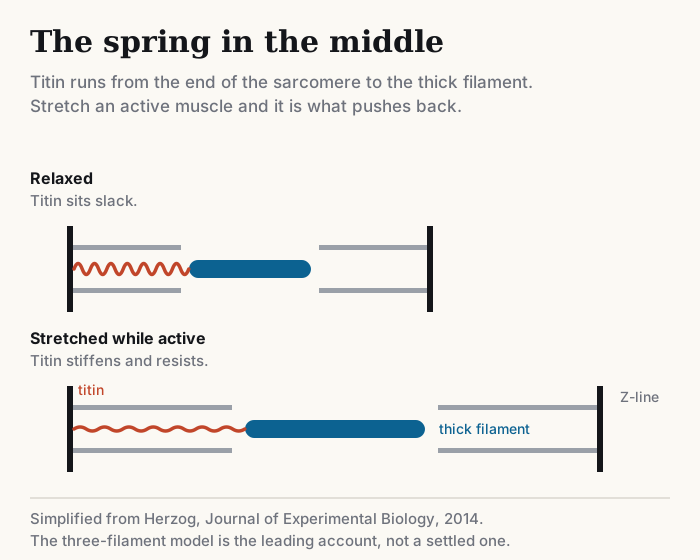
The first is mechanical. Inside every muscle fibre sits titin, a protein so long it spans half a sarcomere and behaves like a spring. The leading account, argued by Walter Herzog, is that titin stiffens once the muscle is active, so a stretched active muscle pushes back with force that a model built from actin and myosin alone cannot explain.[3] Herzog is careful about it too. His own paper calls the idea "not fully proven".
The second is neural. Your nervous system does not drive a lowering rep the way it drives a lifting one. Motor units fire at systematically lower rates during lengthening contractions, and untrained people usually cannot fully activate a muscle during a maximal one at all.[4] So you are strongest in the half of the rep your brain is most reluctant to commit to.
What It Looks Like in Practice
For a first pull-up, the protocol is short enough to memorise. Step off a box or jump so your chin starts above the bar. Pull your shoulders down and away from your ears. Lower for a five count. When five gets easy, go to eight.
Three to five of those, two or three times a week, with a full day in between. End the set the moment the descent stops being controlled, because a rep you drop through is a rep that trained nothing.
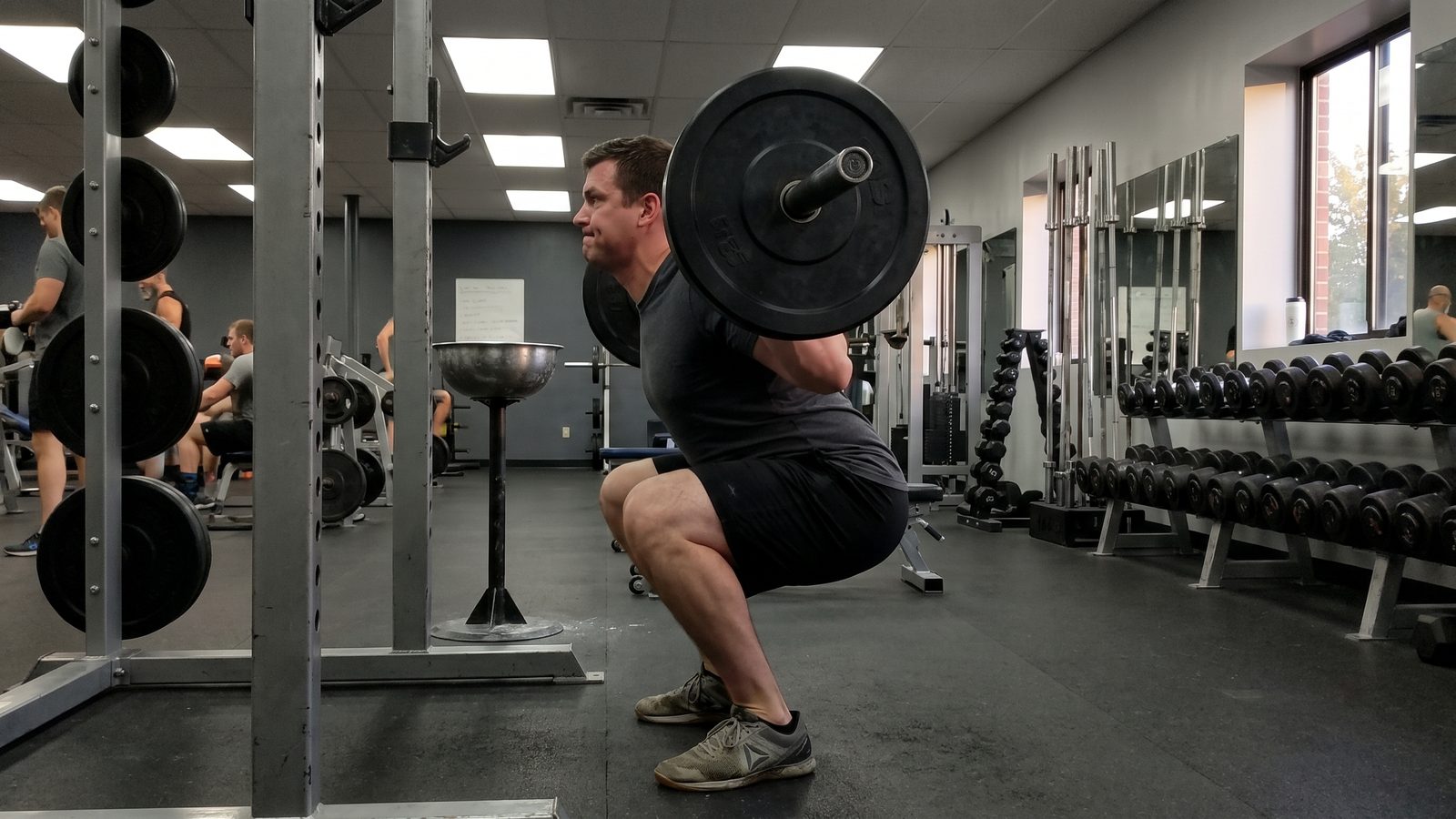
The same idea scales to anything you have stalled on. Load the bar past what you can press, take it out with a spotter or with safety pins set, and lower it under control. Ten weeks of loading the lowering phase 40 percent heavier than the lifting phase raised maximum isometric knee extension strength by 18 percent in already strength-trained men, against 1 percent in a control group that carried on training as usual.[5]
References
- Nuzzo JL, Pinto MD, Nosaka K, Steele J. The eccentric:concentric strength ratio of human skeletal muscle in vivo: meta-analysis of the influences of sex, age, joint action, and velocity. Sports Medicine. 2023;53:1125-1136. doi:10.1007/s40279-023-01851-y
- Hollander DB, Kraemer RR, Kilpatrick MW, et al. Maximal eccentric and concentric strength discrepancies between young men and women for dynamic resistance exercise. Journal of Strength and Conditioning Research. 2007;21(1):34-40. doi:10.1519/R-18725.1
- Herzog W. The role of titin in eccentric muscle contraction. Journal of Experimental Biology. 2014;217:2825-2833. doi:10.1242/jeb.099127
- Duchateau J, Enoka RM. Neural control of lengthening contractions. Journal of Experimental Biology. 2016;219:197-204. doi:10.1242/jeb.123158
- Walker S, Blazevich AJ, Haff GG, et al. Greater strength gains after training with accentuated eccentric than traditional isoinertial loads in already strength-trained men. Frontiers in Physiology. 2016;7:149. doi:10.3389/fphys.2016.00149
- Spudic D, Nosaka K. Eccentric-only versus concentric-only isokinetic strength training effects on maximal voluntary eccentric, concentric and isometric contraction strength: a systematic review and meta-analysis. Sports Medicine - Open. 2025;11:95. doi:10.1186/s40798-025-00887-w
- Hody S, Croisier JL, Bury T, Rogister B, Leprince P. Eccentric muscle contractions: risks and benefits. Frontiers in Physiology. 2019;10:536. doi:10.3389/fphys.2019.00536